Building an Automated Appointment Booking AI Voice Assistant with Vapi, Twilio, and Cal.com

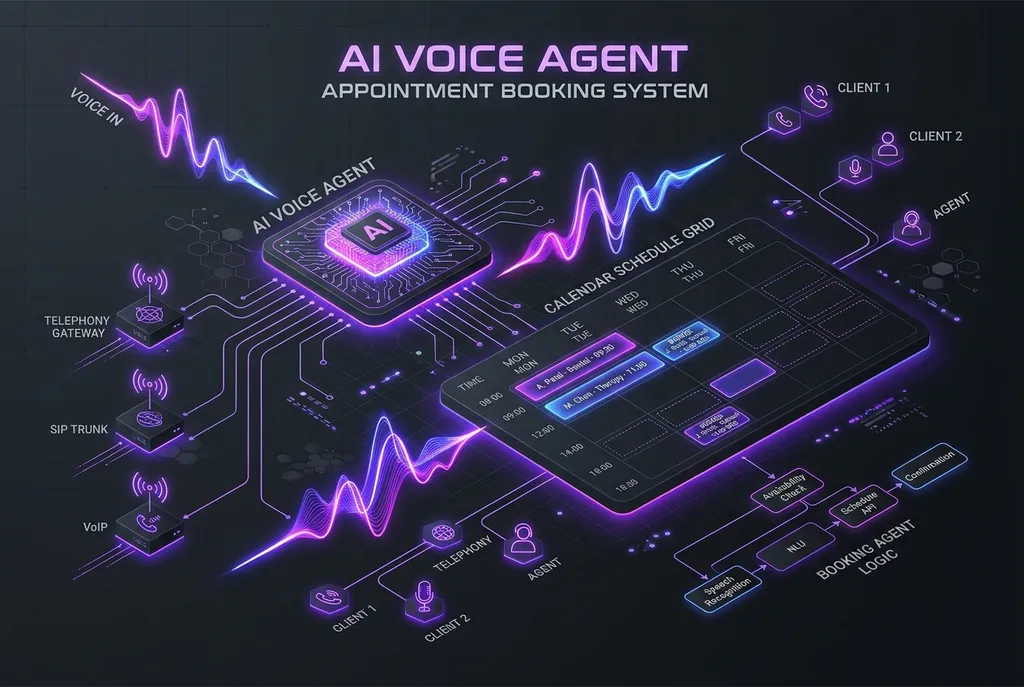
Missed calls cost service-based businesses thousands of dollars in lost revenue every month. Whether it’s a dental practice, real estate agency, law firm, or B2B consultancy, over 60% of potential clients will not leave a voicemail—they simply hang up and call a competitor.
Hiring 24/7 front-desk staff or third-party call centers is expensive, prone to human error, and rarely scales.
With modern conversational Voice AI, we can deploy an Autonomous AI Voice Receptionist that answers incoming calls within one ring, answers complex business questions conversationally, checks live calendar availability, and books appointments directly into your schedule—with zero human intervention.
In this guide, I will break down the end-to-end architecture for building an automated booking voice agent using Vapi, Twilio, and Cal.com.
High-Level System Architecture
  Caller (Phone/PSTN)
         │
         ▼
  ┌──────────────┐
  │ Twilio Voice │  (Inbound SIP Trunk / Carrier Gateway)
  └──────┬───────┘
         │ Bidirectional Audio Stream
         ▼
  ┌──────────────┐
  │   Vapi AI    │  (STT: Deepgram Nova-2 + LLM: GPT-4o / Claude + TTS: Cartesia)
  └──────┬───────┘
         │ Function / Tool Calling Webhook
         ▼
  ┌──────────────┐
  │ FastAPI /    │  (Middleware: Timezone normalization & Slot Validation)
  │ n8n Webhook  │
  └──────┬───────┘
         │ REST API
         ▼
  ┌──────────────┐
  │ Cal.com API  │  (Real-Time Slot Availability & Event Creation)
  └──────┬───────┘
         │
         ├──> Google Calendar / Outlook Sync
         ├──> Twilio SMS Confirmation to Caller
         └──> CRM Update (HubSpot, GoHighLevel, Supabase)
1. The Real-Time Voice Pipeline (Vapi)
A voice bot must feel natural. If the caller experiences a 2-second pause after speaking, the illusion breaks. Vapi orchestrates the low-latency triangle:
- Speech-to-Text (STT): Deepgram Nova-2 with streaming transcripts (sub-150ms).
- Intelligence (LLM): GPT-4o mini or Claude 3.5 Haiku with streaming tokens and strict tool calling definitions.
- Text-to-Speech (TTS): Cartesia Sonic or ElevenLabs Turbo v2.5 delivering natural emotional inflection and immediate audio buffering.
Vapi handles barge-in out of the box. When the caller interrupts the AI (“Wait, do you have anything after 3 PM instead?”), Vapi instantly cancels the active audio buffer and re-prompts the model.
2. Defining the Tool Calling Schema
To allow the voice agent to interact with your booking engine, we configure two distinct server-side tools in Vapi:
Tool 1: check_available_slots
Triggered when the caller asks about availability:
{
  "name": "check_available_slots",
  "description": "Checks available calendar booking slots for a given date range.",
  "parameters": {
    "type": "object",
    "properties": {
      "date": {
        "type": "string",
        "description": "Target date in YYYY-MM-DD format (e.g., 2026-11-04)"
      },
      "timezone": {
        "type": "string",
        "description": "Caller timezone, defaults to America/New_York"
      }
    },
    "required": ["date"]
  },
  "server": {
    "url": "https://api.yourdomain.com/v1/voice/slots"
  }
}
Tool 2: book_appointment
Triggered once the caller confirms a specific date, time, and contact information:
{
  "name": "book_appointment",
  "description": "Reserves and confirms an appointment on Cal.com.",
  "parameters": {
    "type": "object",
    "properties": {
      "start_time": {
        "type": "string",
        "description": "ISO 8601 timestamp of chosen slot (e.g. 2026-11-04T15:00:00Z)"
      },
      "caller_name": {
        "type": "string",
        "description": "Full name of the caller"
      },
      "caller_phone": {
        "type": "string",
        "description": "Phone number for SMS reminder"
      },
      "caller_email": {
        "type": "string",
        "description": "Email address for calendar invite"
      }
    },
    "required": ["start_time", "caller_name", "caller_phone"]
  },
  "server": {
    "url": "https://api.yourdomain.com/v1/voice/book"
  }
}
3. Implementing the Middleware with FastAPI & Cal.com API
Here is how the backend webhook handler processes slot checks and books the appointment in Python:
from fastapi import FastAPI, HTTPException
from pydantic import BaseModel
import httpx
import os

app = FastAPI()
CALCOM_API_KEY = os.getenv("CALCOM_API_KEY")
EVENT_TYPE_ID = int(os.getenv("CALCOM_EVENT_TYPE_ID", "124801"))

@app.post("/v1/voice/slots")
async def check_slots(payload: dict):
    target_date = payload["message"]["toolCalls"][0]["function"]["arguments"]["date"]

    async with httpx.AsyncClient() as client:
        res = await client.get(
            f"https://api.cal.com/v2/slots/available",
            params={
                "eventTypeId": EVENT_TYPE_ID,
                "startTime": f"{target_date}T00:00:00Z",
                "endTime": f"{target_date}T23:59:59Z",
            },
            headers={"Authorization": f"Bearer {CALCOM_API_KEY}"}
        )

    slots_data = res.json().get("data", {}).get("slots", {})
    available_times = [slot["time"] for slot in slots_data.get(target_date, [])]

    if not available_times:
        return {"result": f"No available openings on {target_date}. Suggest alternative dates."}

    # Return formatted readable times for the voice agent
    readable_slots = [t.split("T")[1][:5] for t in available_times[:3]]
    return {"result": f"Available times on {target_date}: {', '.join(readable_slots)}"}
4. Post-Call Automation & SMS Follow-Up
The customer experience shouldn’t stop when the phone call ends:
- Vapi End-of-Call Webhook: Fires immediately upon hang-up with structured variables (
duration,recording_url,transcript,summary). - Instant SMS via Twilio:
“Hi John! Your appointment with Dr. Miller is confirmed for Wednesday, Nov 4 at 3:00 PM. Here is your calendar link: cal.com/b/98124. Reply STOP to cancel.”
- CRM Sync: Updates contact records in HubSpot, GoHighLevel, or Salesforce, tagging the lead source as
Voice AI Receptionist.
5. Production Hardening: Avoiding Common Pitfalls
- Timezone Discrepancies: Never let the LLM guess UTC offsets. Always enforce explicit timezones in the system prompt based on the Twilio phone number prefix or customer profile.
- Race Conditions: If two callers attempt to book the same slot simultaneously, handle Cal.com
409 Conflictgracefully with a fallback: “That slot was just claimed a moment ago. How does 3:30 PM sound instead?” - Human Transfer Fallbacks: If the caller expresses frustration or requests human assistance, trigger an immediate SIP transfer (
transferCallaction) to route the call to a human supervisor.
Ready to Deploy a Voice AI Agent for Your Business?
I help companies, clinics, and agencies design and deploy custom, high-conversion Voice AI agents that run 24/7 without dropped calls or awkward pauses.
If you want to automate your inbound bookings, qualify leads automatically, or integrate telephony into your CRM:
👉 Book a Discovery Call or email me directly at smrusselofficial@gmail.com to discuss your architecture.

Written by S M Russel
Full-Stack AI Engineer, Systems Architect & Founder at Assembly Minds
I architect autonomous multi-agent workflows (LangGraph), real-time conversational Voice AI agents (Pipecat), and containerized Full-Stack Cloud SaaS with Python, Next.js, and Docker.
Related Architecture Deep Dives
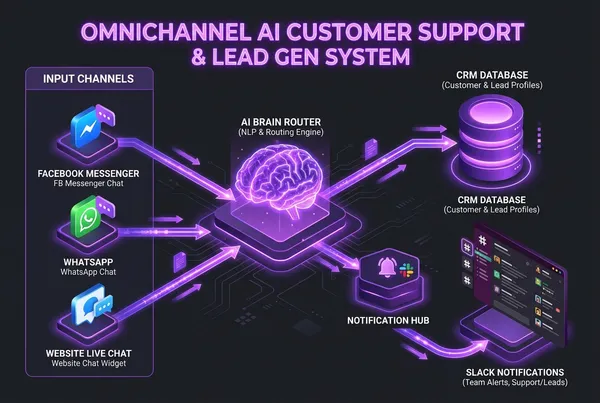
Architecting Omnichannel AI Customer Support & Automated Lead Systems
How to capture, qualify, and convert leads 24/7 across Website Live Chat, Facebook Messenger, and WhatsApp with intelligent AI routing, webhook automation, and instant CRM sync.
Architecting Sub-700ms Real-Time Voice AI Agents with Pipecat and Twilio
A practical engineering deep-dive on designing production voice telephone agents with ultra-low latency, bidirectional streaming, and natural turn-taking.